
Overview

The early 1900s were marked by monumental change. Modern inventions — electricity, the automobile, assembly line production, sleek airplanes and skyscrapers — revolutionized the American way of life. Social developments, such as the women’s suffrage movement, had a significant impact on American society. Changes also extended to the very make-up of the nation’s population. The arrival of 15 million immigrants between 1890 and 1915 changed the complexion of the country’s demographics.

These technological and social changes provided new subjects for artists of the era. Domestic scenes, like Ada Gilmore’s watercolor of quilts hanging on laundry lines, were revolutionary when compared to the subjects portrayed by the male artist majority. Margaret Law, Elizabeth Olds and Henrietta Shore’s paintings of racial minorities are evidence of the modern democratic philosophy of breaking down class, race and gender barriers. Self-portraits, like the paintings by Florine Stettheimer and Kathleen McEnery, show strong, confident women.

In addition to exploring new subjects, female students of Robert Henri experimented with an amazing variety of media and styles. They experimented with bold colors, angular forms and, new or revived techniques. Margaret Bruton’s “Helen at Sargent House Studio” is an example of the use of striking, bold colors. Helen Loggie who originally studied painting with Henri also experimented in drawing and etching. Elizabeth Eyre de Lanux’s “Tapestry Rug with Indian Motif” is an example of the many decorative arts produced by Henri’s women students.

The art of Henri’s students also demonstrated their new, modern attitudes. Minerva Teichert’s “Zion Ho! (Handcart Pioneers)” portrays the pioneer woman as a central figure in the westward expansion. And Hilda Belcher’s “Go Down Moses” illustrates the humanity of African Americans at a time when segregation was still a part of the nation’s culture.
Continued Progress

As Colorado and Utah moved into the Progressive and New Deal Eras of the 1920s and 1930s, their cultures and the artworks the women living there created took a turn toward the modern. These periods both brought a focus on bettering society and creating more support for women, children, and families throughout the United States.5 This oftentimes included more support for the arts and artists through programs like the WPA and the founding of art institutions, organizations, and societies.

There was a sense of hope coming also from women’s suffrage, in the United States passed at the national level in 1920.

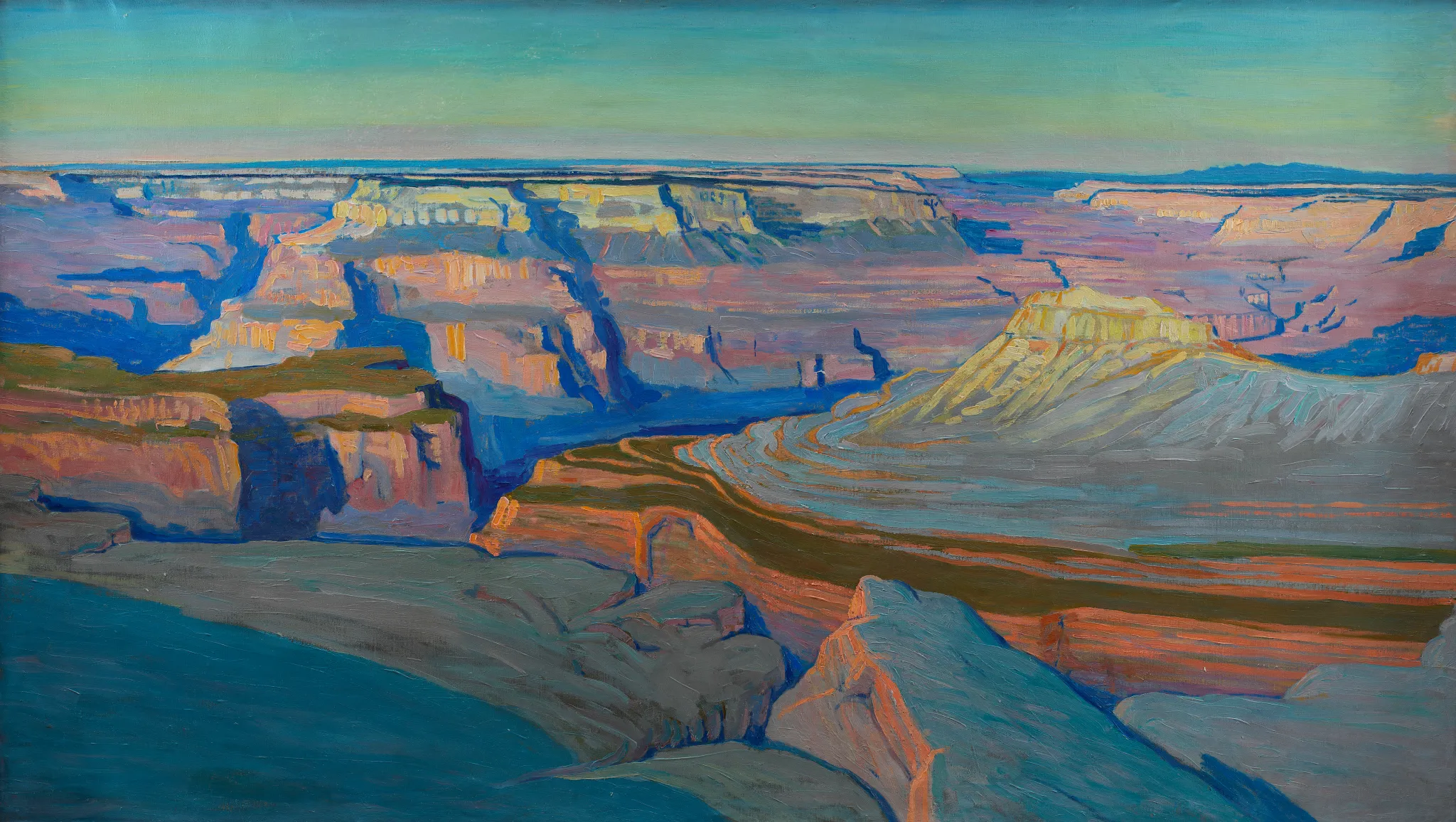
Artists started to paint the landscape with fresh eyes and approaches—influenced by the trends of modernism that came out of Europe at the turn of the century and then spread to artists around the world, including in the U.S. The compositions are tighter, emphasizing shape, imagined color, line, and texture more than the vastness and largeness of the landscape. Artists such as Utah’s Mabel Frazer (1887-1981), Louise Richards Farnsworth (1878-1969), and Florence Ware (1891-1972), and Colorado’s Elisabeth Spalding (1868-1954) and Annie Van Briggle Ritter (1868-1929), embraced new ways of thinking about and depicting the West, using vibrant, dynamic landscapes to reflect cultural optimism, mobility, and reform.

E. Spalding’s Cedar from Rock Subject (Colorado) (1929) embodies these changes. Instead of emphasizing the vast grandeur of the Colorado Rockies, Spalding places a lone tree at the center of her composition, the multicolored layers of rock radiating out beneath it. In L. Richard Farnsworth’s Haystacks (1935), the mounds of bright yellow cut hay are as physically and visually dominant as the purple Wasatch Mountains in the background.

Their paintings emphasize movement, the play of light and shadow, and an overall brightness and modern sensibility to the land in the west. They stand in sharp contrast to the daunting and impenetrable wilderness of the nineteenth-century Hudson River School depictions. These bold colors and undulating lines paint the Utah and Colorado mountains and desert as something modern, fresh, and hopeful.

Legacy

Together these artists show us that the West and its landscape cannot be neatly divided into masculine and feminine; or wild and civilized; it is always both. The dominant narrative likes to imagine the West as monolithic, but these women and their work show it was never that simple. Their artwork and depictions of the West dismantle its story as a singular male domain. Notably, as white women, their work and this deconstruction has limits. The complexities of settler colonialism, borderlands, and racism are largely absent from their work, as are, for the most part, Native American peoples and their communities (the exception in this particular group of artists may be L. Gilpin, who spent significant time photographing Navajo people). Their art does not usually challenge the racial myths that dominate how the West has been understood and portrayed. Despite this, their art reveals some of its complexity rather than its myth.

Bibliography

This biography is adapted from the articles “Thoroughly Modern: Henri’s Women” by Christopher Wilson, “LDS women in art and culture” by Noelle Baldwin, and “Women Artists: Reframing the Rockies” by Emily Larsen.