

Overview
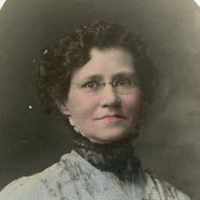
Aretta Young is a significant early Utah artist whose dedication to receiving education and teaching others raised the quality and skill of Utah’s visual Arts. Born to a pioneer family in St. Charles, Idaho, Young faced much hardship in her early life. Her father described her as a “frail child,” and at age fourteen, she contracted a severe case of Typhoid, which almost killed her and prevented her from attending school. At age 19, in 1883, despite her impoverishment and sickness, Young entered the BY Academy and started her lifelong commitment to education and Brigham Young University. After gaining her teaching certificate in 1885, Young began her career as an elementary teacher, bringing her to teach students and teachers across the state. By the late 1880s, Young was well on her way to becoming a leader in Utah education, an accomplished poet, and a burgeoning artist.
Aretta Young’s artistic career took off in the late 1890s when art became the primary focus of her education and teaching. The first mentions of her role as an art educator were in 1897 and 1898, when she lectured on “The Pedagogical Function of Drawing” and was recorded as a member of the Ruskin Club for Art. Young was lecturing on art and judging art competitions in 1900, when she received her Bachelor’s in Pedagogy from B.Y Academy, and became a professor. In 1905, she was awarded a scholarship to attend Columbia University, where she studied with the well-known artist Arthur W. Dow, where three of her paintings allegedly won first place in art competitions. Importantly, Young’s return to Provo and B.Y. Academy in 1906 brought increased artistic skills and knowledge to Utah from the East.
Towards the end of her life, Young was a widely recognized BYU matriarch, professor, poet, and skilled artist. In 1920, she became faculty at BYU, where she was involved in women’s organizations, the BYU art gallery, and often presented on art for literary societies. She likewise served on an art committee to celebrate the Pilgrims’ landing and participated in three art exhibitions in Provo and at BYU. Since her death from pneumonia in 1923, Young’s contributions to Utah’s arts have been posthumously recognized through multiple exhibitions and publications of her artistic works.